

Product description
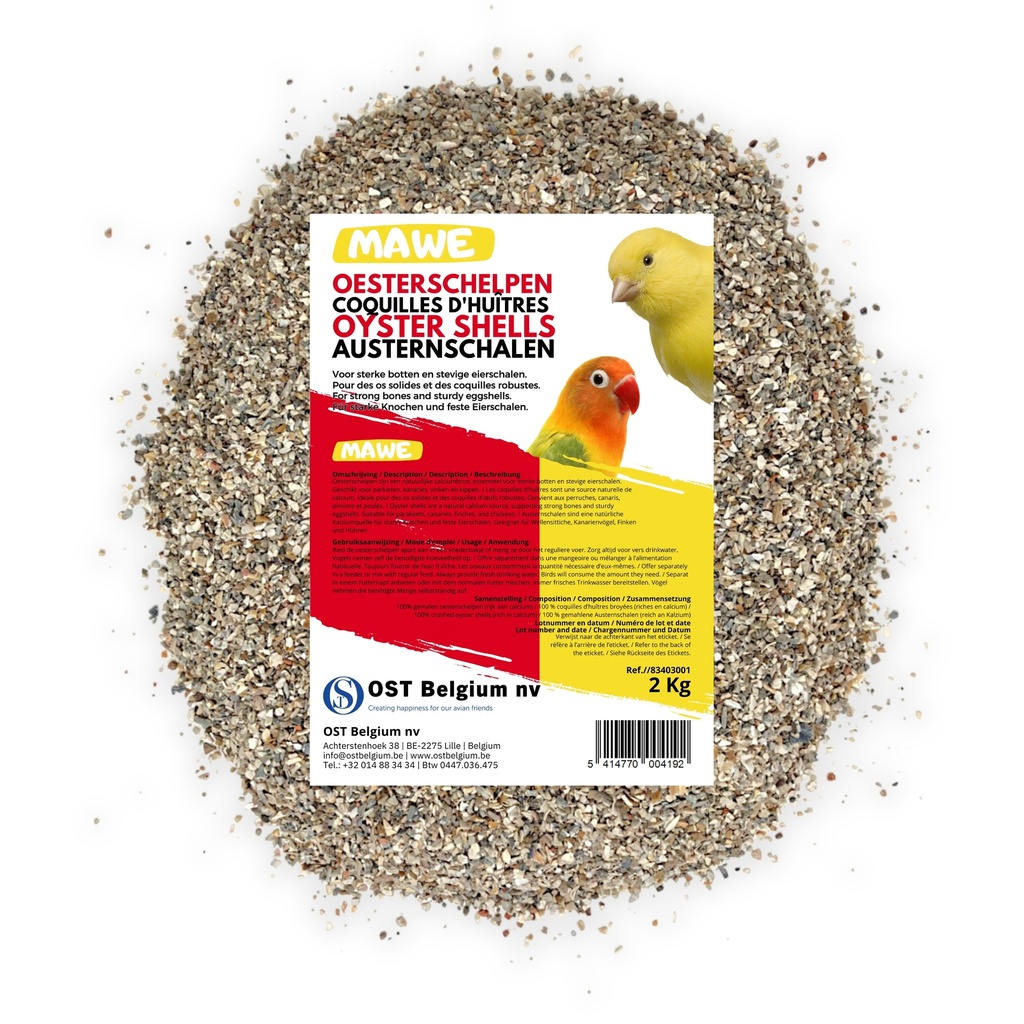
Oyster shells as a calcium source, in 2 kg bags.
Oyster shells are broken shell and therefore a natural source of calcium. That calcium is needed for strong bones, a healthy beak and — in breeding birds — for eggshells that do not stay too thin.
The shells also help to grind the food, though that is their second role: where gizzard grit is hard and does not dissolve, oyster shell first and foremost releases calcium.
You offer them separately in a feeding bowl or mix them through the feed. Certainly in the breeding season, when the birds use more calcium, it is important that some is always there. Suitable for parakeets, canaries, finches and also for chickens.
Packed in 2 kg bags. A box contains 7 bags. For larger customers there are 25 kg bags.
Product data & specifications
All data for this item, with the barcode of the bag and of the box.
| 2 kg | |
|---|---|
| Identification | |
| Item number | 83403001 |
| Barcode bag EAN-13 | 5414770004192 |
| Properties | |
| Contents | 2 kg |
| For | Cage and aviary birds and poultry |
| Use | A calcium source, and grit too |
| Net weight per bag | 2 kg |
| Packaging — box | |
| Pieces per box | 7 bags |
| Barcode box EAN-13 | 5414770004208 |
| Net weight box | 14 kg |
| Gross weight box kg | — |
| Height box cm | — |
| Width box cm | — |
| Length box cm | — |
Benefits
Why breeders reach for this above all in the breeding season.
Calcium from a natural source
Broken shell, no additives. The bird takes up what it needs.
Important for the eggshell
Laying birds use a lot of calcium. A shortage shows up in thin or soft shells — exactly what you want to avoid.
Good for bones and beak too
Not only during breeding: calcium remains necessary all year round.
For birds and poultry
Parakeets, canaries and finches, but just as well chickens. One item you sell to a wider circle of customers.
Handy 2 kg bag
The format for the shop shelf and for the private breeder. Per box of 7 bags, with its own barcode on the box.
Which mineral when?
Gizzard grit, oyster shell and shell sand each do something different. This is how they complement each other.
1. First the grinding
Every seed-eating bird needs hard particles in its gizzard to grind the seed. Sharp gizzard grit or bird grit should therefore always be available, all year round. Choose the grain to suit the bird: the fine one for canaries and other small seed-eaters, the coarse one for large parakeets and hookbills.
2. Alongside it, the calcium
Oyster shells are not a substitute for gizzard grit but an addition: they dissolve and supply calcium for bones, beak and eggshells. Put them in a separate bowl next to it, and make sure they do not run out, certainly during the breeding season.
3. And on the floor below
Shell sand goes on the floor of the cage or aviary. It absorbs moisture and dirt, and the birds pick up some calcium from it along the way. So it does not replace the first two: it is bedding with a little extra.
| What for | When | |
|---|---|---|
| Sharp gizzard grit — fine | Grinding the seed in the gizzard | Canaries, Gouldian finches, zebra finches and other small seed-eaters |
| Sharp gizzard grit — coarse | Grinding the seed in the gizzard | Large parakeets and hookbills |
| Bird grit | Grit for everyday use | Cage and aviary birds; 25 kg bag for high consumption |
| Oyster shells | Calcium for bones, beak and eggshells | All year round, extra during the breeding season |
| Shell sand | Bedding that absorbs moisture | On the floor of cage and aviary |
Frequently asked questions
What customers ask us most often about this item.
What are oyster shells for?
As a calcium source. The calcium supports bones, beak and the forming of strong eggshells in laying birds.
Which animals are they suitable for?
For parakeets, canaries, finches and other cage and aviary birds, and also for chickens.
How do I offer them?
Separately in a feeding bowl or mixed through the feed. Make sure some is always available, certainly in the breeding season.
What is the difference between gizzard grit, oyster shells and shell sand?
Gizzard grit is hard and does not dissolve: it stays in the gizzard and grinds the seed there. Oyster shells are calcium and do dissolve: they serve as a calcium source for bones and eggshells. Shell sand is first of all bedding, from which the bird also picks up some calcium. So they do not replace one another — many breeders offer them side by side.
How much should I give?
You do not have to measure anything out. Simply make sure some is always available in a separate bowl; the birds take what they need. Refresh regularly so it stays clean.
How is it delivered?
In 2 kg bags, per piece or per box of 7 bags. The box has its own barcode so you can scan it in one go.